
Islamic Events
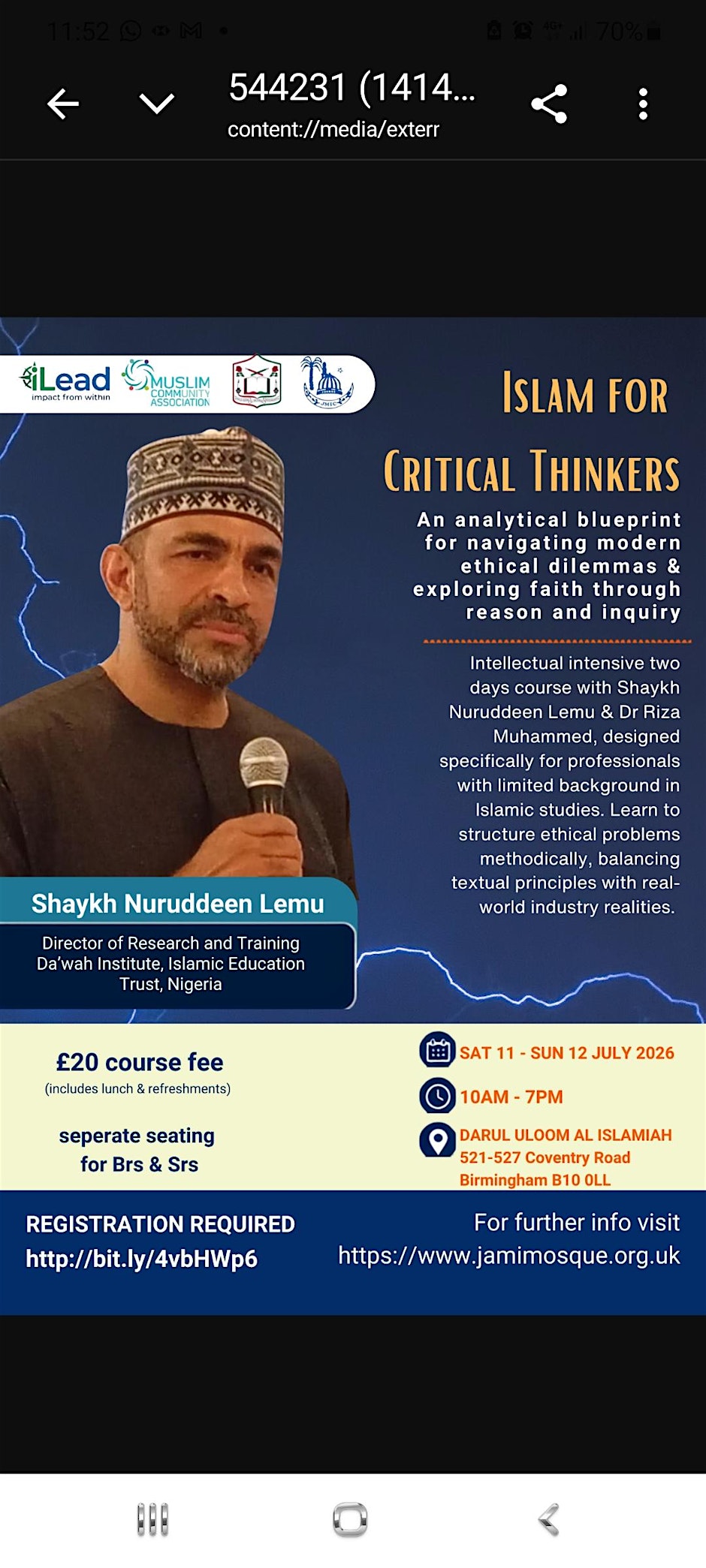
ISLAM FOR CRITICAL THINKERS
About This Event
Learn to structure ethical problems methodically, balancing textual principles with real-world industry realities.
Islam for Critical Thinkers
10am - 7pm, Sat 11 - Sun 12 July 2026
Darul Uloom al Islamiah, 521-527 Coventry Road, Small Heath B10 0LL.
An analytical blueprint for navigating modern ethical dilemmas & exploring faith through reason and inquiry
with Shaykh Nurudden Lemu & Dr Riza Muhammed.
?
Exploring faith through reason and inquiry
2 days course with seperate seating for brothers and sisters. Course fee includes lunch and refreshments for both days.
The Challenge
As a modern professional—whether you work in technology, healthcare, law, or business—you are trained to solve complex, ambiguous problems using data, logic, and frameworks. Yet, when faced with workplace ethical dilemmas, many find a gap between their professional analytical skills and traditional religious guidance.
You don’t need to memorize dense historical texts or change your career path to close this gap. You just need the right analytical framework.
The Solution: A "First Aid" Framework
Islam for Critical Thinkers
is an intellectual intensive engineered specifically for professionals with zero background in Islamic studies.
This course treats Islamic ethics not as a rigid list of rules, but as an advanced
operating system for critical thinking
. Think of it like a medical "First Aid" kit: it won't turn you into a specialist surgeon (or a religious jurist), but it equips you with the exact logical tools needed to assess workplace ethical situations, make reasoned decisions, and recognize precisely when a dilemma is complex enough to require specialized expert advice.
The Decision-Making Sandbox
We strip away dense technical jargon and explain the core pillars of Islamic reasoning using universal logical concepts you already use daily:
The System Core (
Usul al-Fiqh
):
The systematic rules governing how foundational evidence is analyzed and processed.
The Guardrails (
Qawa’id Fiqhiyyah
):
Universal legal maxims—similar to systemic risk-mitigation rules (e.g.,
"Harm must be mitigated or eliminated"
).
The System Goals (
Maqasid al-Shari’ah
):
The ultimate objectives—ensuring choices actively protect and preserve Life, Mind, Wealth, Faith, Family, and Dignity.
The Environment (
Fiqh al-Waqi’
):
Integrating data from your specific industry, because data without real-world context creates flawed outcomes.
What You Will Walk Away With
An Objective Framework:
Learn to structure ethical problems methodically, balancing textual principles with real-world industry realities.
Intellectual Agility:
Discover why differences in ethical interpretations are a designed-in feature of flexibility rather than a flaw, giving you tools for respectful, civil disagreement.
Risk Mitigation:
Develop the critical capacity to spot extreme, harmful, or flawed arguments by measuring them against universal benchmarks of justice and human dignity.
Defined Boundaries:
Know exactly when to deploy immediate ethical "first aid" on your own, and exactly when an issue must be escalated to specialists.
Course Features
Zero Jargon:
All concepts are translated into plain English and explained using highly visual, relatable mental models.
Hands-on Case Studies:
Work in collaborative teams through practical scenarios to pressure-test the frameworks.
Built for Professionals:
A high-impact format tailored to fit into a demanding career schedule.
Who Is This For?
Muslim professionals, executives, and leaders in Healthcare, Law, Engineering, IT, NGOs, Education, and Entrepreneurship who want to lead their industries with spiritual accountability and intellectual rigor.
The course will be delivered by Muhammad Nuruddeen Lemu who is a distinguished Nigerian Islamic scholar, educator and researcher, widely recognised for his work in Islamic law, peacebuilding and contemporary Muslim thought. He serves as the Director of Research and Training at the Islamic Education Trust (IET) and the Da’wah Institute in Minna, Nigeria, leading initiatives in interfaith engagement, intra-faith cooperation and leadership development.
Islamic Scholarship and Training
Born into one of West Africa’s most respected scholarly families, Shaykh Lemu began his study of the Islamic sciences under his parents, Justice (Dr.) Sheikh Ahmed Lemu, OFR, and Sheikha B. Aisha Lemu, MON, before continuing his studies with leading scholars in Islamic law and maqasid studies and pursuing advanced Arabic studies in Amman, Jordan.
Academic Background
Alongside his traditional Islamic training, he holds a degree from Ahmadu Bello University, an MSc from The University of Edinburgh, and is currently pursuing a PhD in Islamic Thought and Civilisation at International Islamic University Malaysia.
Teaching and Global Contribution
An accomplished educator and trainer, Shaykh Lemu has delivered lectures and seminars in more than forty countries. , co-authored over twenty books, and serves as an adjunct lecturer and researcher in Islamic Law at the University of Ilorin, Nigeria.
Riza Mohammed
Dr. Riza Mohammed is a Trauma and Orthopaedic Surgeon, educator, mentor and leadership trainer with more than 30 years of experience serving communities across the Caribbean, the United Kingdom and internationally. A member of the Faculty of Academic and Clinical Educators (UK), he supervises medical students at the University of Liverpool and serves as an Associate of the General Medical Council and PLAB examiner, reflecting his longstanding commitment to excellence in medical education and professional development.
Alongside his distinguished medical career, he is deeply engaged in leadership development, mentoring and community empowerment. He currently serves as Director of ILead, Executive Board Member of the European Academy of Quranic Studies (EAQS), Chairman of the Caribbean Muslim Network. Through these roles, he has led numerous initiatives focused on nurturing ethical leadership, spiritual growth and community transformation.
An accomplished educator, trainer and curriculum designer, he has developed and delivered transformative educational and leadership programmes for students, professionals and emerging leaders worldwide. His work integrates faith-based values, character development and service, with a particular emphasis on mentoring and purposeful leadership.
Dr. Mohammed is also a prolific author and editor. His publications include Journey Through Islam, Islam: The Way of Revival, In the Early Hours: A Guide to Spiritual and Self Development (editor), Islamic Workers Training Manual (2 volumes), The Changemaker: From Idea to Impact, The Soul’s Compass, 15 Minutes a Day: The MIA Qur’an Study Guide, Leading with Impact: The Prophetic Model (editor), and Mentoring for Life. Through his writing, teaching and leadership, he continues to inspire individuals and organisations to lead with vision, integrity and impact.
Date & Time
Starts
Sat 11 Jul 2026, 10:00 AM
Ends
Sat 11 Jul 2026, 7:00 PM

